In this article11 sections
- 01In 30 seconds
- 02How much time do Indians spend on their phones?
- 03How do I check my screen time on Android?
- 04How do I set app timers on Android?
- 05How do I use Focus mode on Android?
- 06How do I set up Bedtime mode on Android?
- 07What should I do about notifications on Android?
- 08Why do Digital Wellbeing settings stop working?
- 09What actually works to reduce screen time on Android?
- 10A 7 day plan to reduce screen time on Android
- 11Where bloc fits
To reduce screen time on Android, open Settings, tap Digital Wellbeing, and check the dashboard to see which apps take your hours. Set app timers on your two or three worst apps, schedule Focus mode for work and Bedtime mode (with grayscale) for night, and cut notifications to a few check-ins a day. Then add the one thing Android cannot give you: a limit you cannot undo in two taps.
That last part is where bloc (by Letsbloc) comes in: a magnet on your fridge and a free app for iPhone and Android. Your apps block on a schedule. Unblocking early means a walk to the kitchen, not a tap in bed. More on that at the end.
You know the pattern. Sunday, 11 pm. You pick up the phone for one WhatsApp reply. Twenty minutes later you are in Reels, the reply unsent, and the Instagram timer you set was deleted on Tuesday.
In 30 seconds
- ·Digital Wellbeing has four tools: dashboard, app timers, Focus mode and Bedtime mode. Use all four.
- ·Each one has a built-in exit that takes seconds, from the same screen that tempts you.
- ·Research says limits work. The weak point is how cheap they are to undo.
- ·The fix is distance: a PIN someone else holds, a phone charged in another room, or a bloc on the fridge.
How much time do Indians spend on their phones?
About 94 percent of phones in India run Android, so these settings are almost certainly already in yours.
The EY and FICCI media and entertainment report found that Indians spent 4.95 hours a day on phone apps in 2024. Most of it was not work: media, meaning social media, films, entertainment, music and casual games, took 69 percent.
Where Indians' phone time goes
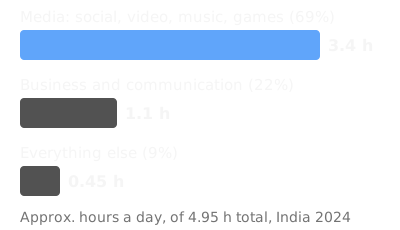
Source: EY and FICCI, 2025. Hours are approximate, worked out from 4.95 hours a day.
How do I check my screen time on Android?
Open Settings and tap Digital Wellbeing. The first time, Google asks you to set up your profile. Google says it is only on some phones and steps vary by device, so if you do not see it, search Settings for "Digital Wellbeing" or "screen time".
The dashboard is the first screen. It shows a chart of today's screen time split by app, plus how many times you unlocked the phone, opened apps, and how many notifications you received.
Before changing anything, write down today's total, unlocks and top three apps. The free screen time calculator turns daily hours into days a year.
How do I set app timers on Android?
- ·Open Digital Wellbeing and tap App timers (or tap the app's name on the dashboard).
- ·Next to the app, tap Set timer and choose a daily limit.
- ·When the time runs out, the app closes and its icon dims for the rest of the day. Timers reset at midnight.
Set them on the two or three apps that top your dashboard, not on everything. Some work or school accounts might not work with app timers.
The catch: to use the app again before midnight, you delete the timer. A couple of taps. There is a PIN for app limits, which helps if someone else sets it; a PIN you know is still a few taps away.
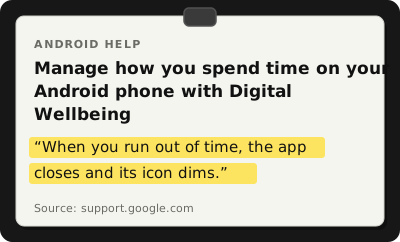
From Android Help, Google's Digital Wellbeing help page, undated.
How do I use Focus mode on Android?
Focus mode pauses a set of apps at once. Good for exam prep or office hours.
- ·In Digital Wellbeing, tap Focus mode.
- ·Tick the apps to pause. When Focus mode is on, you cannot use these apps and you do not get their notifications.
- ·Tap Turn on now, or Set a schedule so it switches on at the same hours every day.
Use the schedule. If turning it on depends on you, it gets skipped on the bad days. For study, try 7 pm to 10 pm on weekdays.
The exit here is Take a break: tap it, choose how long, and the paused apps come back. Handy for a quick reply. Also where most Focus mode plans end.
How do I set up Bedtime mode on Android?
- ·In Digital Wellbeing, tap Bedtime mode, then Bedtime routine.
- ·Pick start and end times and which days, or choose Turn on while charging between set hours.
- ·Pick what it does: Grayscale (a black and white screen), Do Not Disturb, keeping the always-on display dark, dimming the wallpaper, and a dark theme.
Turn on grayscale. Reels, Shorts and games are designed in colour, and a black and white feed is a duller feed (research below). Start it about an hour before you want to be asleep.
What should I do about notifications on Android?
Notifications are the trigger for a lot of screen time. One message, and twenty minutes later you are in Reels.
A two week field experiment with more than 200 people living in India, published in Computers in Human Behavior in 2019, tested three approaches against a control group:
- ·Notifications three times a day, at 9 am, 3 pm and 9 pm: people felt happier, more productive, less stressed and more attentive, and unlocked their phones fewer times than the control group.
- ·Hourly batching brought few benefits.
- ·No notifications at all: no better off than the controls, more anxious, and no fewer unlocks.
Three ways to handle notifications, from a two week experiment in India
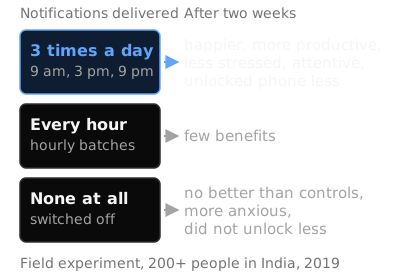
Source: Fitz, Kushlev, Jagannathan, Lewis, Paliwal and Ariely, 2019, more than 200 participants in India over two weeks.
So the lesson is not "switch everything off". It is "check in a few times a day, on purpose". Android has no three-times-a-day switch, but you can get close: turn off notifications for every app that is not a person talking to you (likes, uploads, offers and game rewards all go), and pick three check-in times for the rest. The free notification audit helps you sort them.
Why do Digital Wellbeing settings stop working?
Each tool above has a built-in exit, and the exit is on the same screen as the temptation.
Each Digital Wellbeing tool, and what it takes to get around it
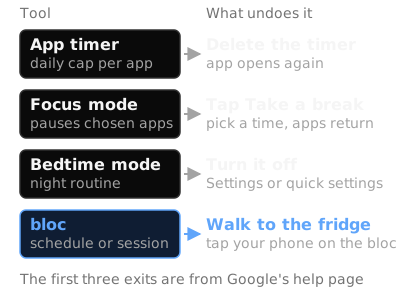
Source: the first three exits are from Google's Digital Wellbeing help page. The bloc step is described below.
None of these exits takes more than a few seconds, and all of them happen while you are holding the phone, usually tired.
That is not a reason to skip the settings. Allcott, Gentzkow and Song, in the American Economic Review in 2022, found that letting people set limits on their future screen time substantially reduces use, which they read as evidence of self-control problems. Their model suggests that self-control problems cause 31 percent of social media use: nearly a third of the scroll is time you would not choose calmly. A temporary push to cut social media use also had persistent effects.
Limits work. The weak point is how cheap they are to undo.
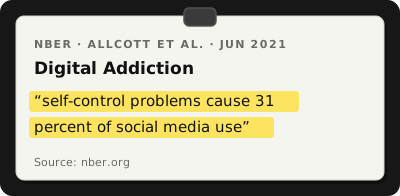
From NBER Working Paper 28936, Allcott, Gentzkow and Song, June 2021 (published in the American Economic Review, 2022).
What actually works to reduce screen time on Android?
- ·Limits set in advance, and notifications in batches. Set them when you are calm, on a schedule, so the decision is not made at 11 pm.
- ·Grayscale. Research led by Alex Holte at the University of Cincinnati Blue Ash College followed about 220 students and found that grayscale contributed to a reduction of smartphone use by an average of 39 minutes per day. Bedtime mode makes it a schedule rather than a nightly decision. More in does grayscale reduce screen time.
- ·Distance. The one Android cannot give you. The settings all live on the phone, so the exit is always in your hand. The limits that hold take more than a tap to undo: a PIN held by someone else, a phone charged in another room, or a physical step you have to get up for. Your legs are slower than your thumb. That gap is where the urge fades.
Same pattern as why you can't stop scrolling: change the environment, not yourself.
A 7 day plan to reduce screen time on Android
- ·Day 1: Open Digital Wellbeing. Write down total screen time, unlocks, and your top three apps.
- ·Day 2: Turn off notifications for every app that is not a person. Pick three check-in times.
- ·Day 3: Set app timers on your top two or three apps.
- ·Day 4: Schedule Focus mode for your study or work block.
- ·Day 5: Set up Bedtime mode with grayscale. Charge the phone outside the bedroom.
- ·Day 6: Count how many times you deleted a timer or tapped Take a break this week.
- ·Day 7: Check the dashboard again and compare with Day 1.
If Day 6 keeps showing the same two apps, that is where a physical block earns its place.
Where bloc fits
bloc is the distance step, made physical. A small magnetic NFC device on your fridge, a free app for iPhone and Android, plus bloc for Chrome for websites. In the app you choose the apps that eat your time, and they get blocked on their own: on a schedule you set (say 10 pm to 7 am, or your study hours), or from a session you start in the app.
Open a blocked app and you see a shield screen instead, with a limited peek if you need a quick look. To unblock early, you walk to the fridge and tap your phone on the bloc. The tap only unblocks. Blocking runs on its own.
The walk is the point. Deleting a timer takes two taps in bed. Walking to the kitchen takes thirty seconds and a decision you are aware of making. Bloc Score shows how often you unblock early, and several phones can pair with one bloc, so a family or flatmates can share it.
Keep the Digital Wellbeing settings, and let the bloc hold the line on the two or three apps you keep overriding. ₹1,699, pay once. See how bloc works.
On an iPhone? See how to reduce screen time on iPhone.
bloc sits on your fridge. Your apps block on a schedule. Unblocking takes a walk. See how bloc works →
Sources
- ·Google Android Help, "Manage how you spend time on your Android phone with Digital Wellbeing"
- ·StatCounter, Mobile OS market share India, September 2026
- ·EY and FICCI, Indian media and entertainment report, 2025
- ·Fitz, Kushlev, Jagannathan, Lewis, Paliwal and Ariely, Computers in Human Behavior, 2019 (summary)
- ·University of Cincinnati, Holte grayscale research, October 2022
- ·Allcott, Gentzkow and Song, "Digital Addiction", NBER Working Paper 28936 (American Economic Review, 2022)
bloc is our product. We make and sell it, so read anything this article says about bloc as the maker's view. Every other claim links to its source.
Spot a mistake? Email support@letsbloc.com. We check it, fix it and update the date above.
Founder of bloc. IIT Kharagpur. Formerly a senior product analyst at BharatPe. Builds bloc full time from Bir, Himachal.
Free tools from bloc
Frequently asked questions
How do I check my screen time on Android?
Open Settings and tap Digital Wellbeing. The dashboard shows today's screen time split by app, how many times you unlocked the phone and opened apps, and how many notifications you received. If you cannot find it, search Settings for 'Digital Wellbeing' or 'screen time', since some phone brands name it differently.
How do I set app timers on Android?
In Digital Wellbeing, tap App timers (or the app's name on the dashboard), tap Set timer next to the app and choose a daily limit. When the time runs out the app closes and its icon dims until midnight. To use the app earlier you have to delete the timer, which is also why timers alone rarely hold.
Does grayscale really reduce screen time?
Research at the University of Cincinnati Blue Ash College with about 220 students found that switching the screen to grayscale contributed to a reduction of smartphone use by an average of 39 minutes a day. On Android you can schedule grayscale through Bedtime mode so it switches on by itself every night.
Why do I keep deleting my own app timers?
Because the exit sits on the same screen as the temptation. Deleting a timer or tapping Take a break in Focus mode takes seconds, usually while you are tired and already holding the phone. Research on screen time limits shows they do reduce use, so the fix is not to drop limits but to make undoing them cost more than a tap: an app limit PIN held by someone else, a phone charged in another room, or a physical block you have to get up for.
Ready to stop doomscrolling for good?
Try bloc, the device that actually keeps you off your phone
One-time purchase · Free shipping across India · 30 day replacement guarantee
Order bloc, from ₹1,699