In this article8 sections
You can't stop scrolling because the feed is built like a slot machine, and it learns from every swipe. Willpower loses to that most nights. What research says works is distance: put the phone, or the apps, somewhere your thumb can't reach in one move.
It is 1:40 am. You opened Instagram to check one message. Now you are watching a stranger renovate a kitchen in Lisbon, and you feel a bit stupid about it. You should not. This is the output of some of the best-funded design work on earth, running on the phones of roughly a billion Indian internet users.
bloc (by Letsbloc) is built on the distance idea: a small NFC magnet for your fridge and a free app for iPhone and Android. Your chosen apps block on a schedule, and unblocking takes a walk to the fridge. ₹1,699, pay once. More on that below. First, why the scroll wins.
In 30 seconds
- ·The average Indian spends 194 minutes a day on social media, about one waking hour in five.
- ·Feeds use the same trick as slot machines: an unpredictable reward every few swipes.
- ·The feed learns from every reaction and picks the next reel to keep you watching.
- ·The cost shows up in attention, sleep and self-esteem.
- ·What works is distance, delay and a real choice. Not trying harder.
How much Indians scroll
Start with one number: 194 minutes. That is how long the average Indian spends on social media each day, according to a 2023 study by the Esya Centre and IIM Ahmedabad. Online games get 46 minutes. OTT streaming gets 44.
Social media gets more than four times the daily minutes of games or streaming
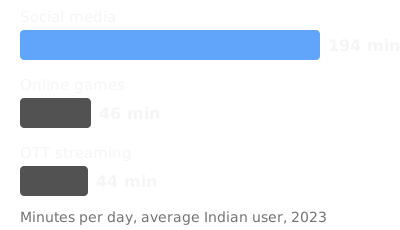
Source: Esya Centre and IIM Ahmedabad, "New age digital media consumption", 2,000 respondents plus in-app data from 2.06 million users across 143 apps, reported by Business Standard, August 2023.
The same study found that 89% of Indian internet users are on social media every day, almost all of it on phones. Zoom out and Sensor Tower counted 1.12 trillion hours on mobile in India in 2024, more than any other country, with about 743 billion of those hours in social media apps. India still has no official data on screen addiction.
Three hours a day is about one in five waking hours
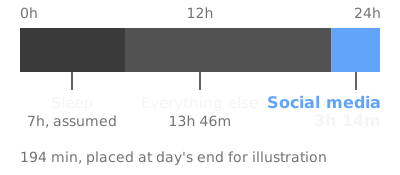
Social media minutes from Esya Centre and IIM Ahmedabad, 2023. The sleep block is an assumption for illustration, not survey data.
It rarely feels like three hours because it arrives in pieces: a reel at the bus stop, three in the lift, forty before sleep.
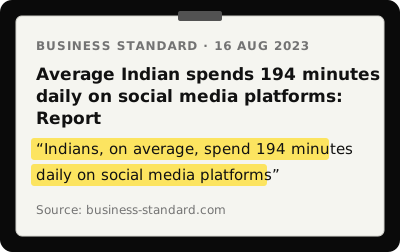
From Business Standard, 16 Aug 2023.
Why you can't stop: it's the loop, not you
Casinos worked out decades ago that uncertainty grips harder than reward. You pull the lever not because you will win, but because you might.
Feeds borrow the same mechanics. Natasha Schüll, who spent years studying slot machine design, calls them "ludic loops": repeated cycles of uncertainty, anticipation and feedback. Tristan Harris, a former Google design ethicist, has compared pull-to-refresh and infinite scroll to a slot machine. Prof. Mark Griffiths of Nottingham Trent University points to variable reinforcement, rewards that arrive at random, as the key to repeated checking.
The loop has four stages, and the third one is deliberately unpredictable
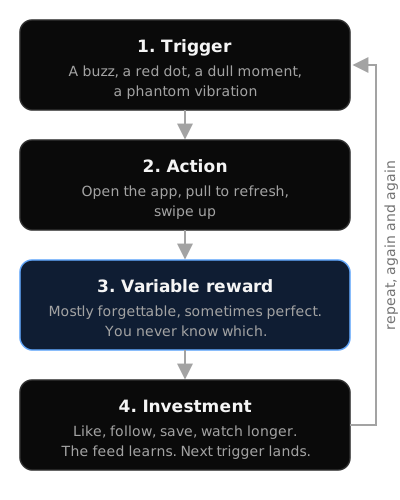
The four stages follow Nir Eyal's Hook Model (Hooked, 2014). The slot machine mechanics inside stage 3 are described by Schüll, Harris, Griffiths and Kruger in University of Michigan IHPI, May 2018.
Each swipe is a tiny bet. Most reels are forgettable. Every so often one is perfect for you. Your brain learns that the next one might be, and the thumb moves before you decide.
The feed is studying you
Instagram has no single algorithm. Each surface (Feed, Stories, Explore, Reels) has its own ranking system, as Instagram head Adam Mosseri explained in 2023. For Reels, it predicts whether you will reshare a reel, watch it to the end, like it, or open its audio page, and serves you more of what scores highest.
Every reaction you have becomes the input for the next reel
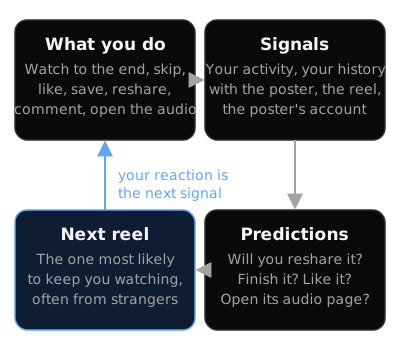
Signals and predictions as described by Adam Mosseri, "Instagram Ranking Explained", May 2023.
The feed is tuned for what keeps you watching. That is not the same as what you would choose for yourself at 11 pm.
What scrolling costs
Attention. A 2026 systematic review of short video addiction found attention and self-control are the functions most affected. One Indian study inside it found a correlation of r = -0.295 between short video addiction and attention span.
Sleep. This is where the bill usually arrives. For the Great Indian Sleep Scorecard 2026, the mattress brand Wakefit ran a self-selected online survey of over 2,500 people. 87.6% use their phone before bed. Nearly 60% go to bed after 11 pm. 48.7% wake up unrested.
Nearly 9 in 10 people surveyed use their phone right before bed
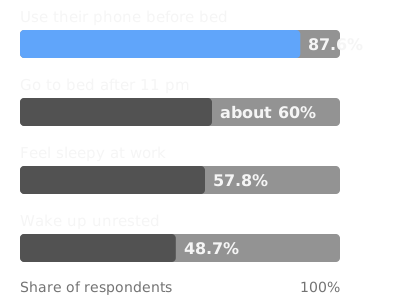
Source: Wakefit, Great Indian Sleep Scorecard 2026, over 2,500 responses, January 2025 to March 2026. "Nearly 60%" is drawn at 60.
Self-esteem. A 2023 Indian review found that 9 of 10 studies linked heavy Facebook and Instagram use to lower self-esteem, with poorer body image and distress coming up too. Part of that is the mirror: in a British study of 175 people aged 18 to 30, 90% had used a filter or edited a photo before posting.
Who it hits hardest. A 2021 meta-analysis of 34,798 people across 32 nations put social media addiction at 31% in collectivist cultures against 14% in individualist ones. India is usually classed as collectivist, though the abstract does not list which nations were sampled.
Social media addiction is about twice as common in collectivist cultures
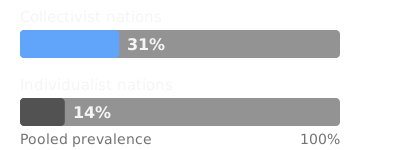
Source: Cheng et al., Addictive Behaviors 2021, 63 samples, 34,798 respondents, 32 nations. The abstract describes the collectivist estimate as about twofold higher. Abstract, DOI.
Why willpower loses
Your phone's built-in screen time limit is defeated by one tap on "Ignore limit for today". The feed has thousands of engineers. You have a tired thumb at 11 pm.
None of the studies below asked anyone to be stronger. They changed the environment so the easy choice became the better one.
What actually works: distance, delay, a real choice
Three studies, three ways to change the environment instead of yourself
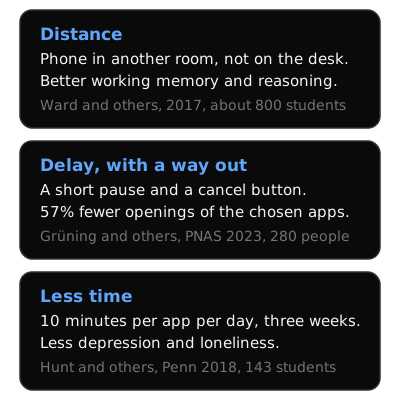
Sources: Ward et al. 2017, Grüning et al. 2023, Hunt et al. 2018.
1. Distance. In 2017, Adrian Ward and colleagues ran two experiments with nearly 800 students. People whose silent phones sat on the desk scored lower on working memory and reasoning than people whose phones were in another room. The effect was strongest in people who depended on their phones most.
2. Delay, with a way out. A 2023 study in PNAS tracked 280 people using a pause app called one sec. Each time they opened a chosen app, a short pause appeared with a cancel button. Over six weeks, openings fell by 57%. A follow-up with 500 people found the cancel option did most of the work; a reflective message did not help.
3. Less time, better mood. In a 2018 University of Pennsylvania experiment, 143 students were randomly assigned to cap Facebook, Instagram and Snapchat at 10 minutes a day each. After three weeks, that group showed significant drops in depression and loneliness.
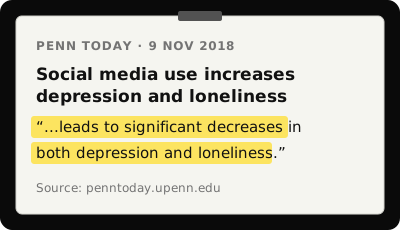
From Penn Today, 9 Nov 2018.
Willpower is a battery. Distance is a wall. Build the wall.
Where bloc fits
bloc is the wall, with one extra step: your legs.
It is a small magnet that sits on your fridge, or any metal surface away from your bed and sofa. In the app you pick the apps that eat your evenings. They get blocked on a schedule you set (say 10 pm to 7 am) or when you start a session from the app. Blocking happens on its own.
To unblock, you walk to the fridge and tap your phone on the bloc. That walk is the whole trick. It puts distance and a few seconds between you and the scroll, often long enough to notice you did not really want to open it.
A blocked evening with bloc: the apps block on their own, only unblocking needs a walk
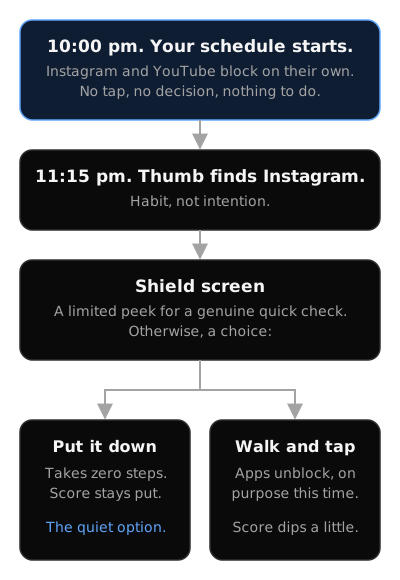
Blocking runs on your schedule or from a session you start in the app. Tapping your phone on the bloc is only ever to unblock. See how bloc works
If you genuinely need a quick check, the shield screen offers a limited peek. A Bloc Score drops a little each time you unblock, so you can see your own pattern. Several phones can pair with one bloc, so a family can share it. bloc for Chrome blocks websites on a laptop.
The more effort it takes to get back to the scroll, the fewer times you do
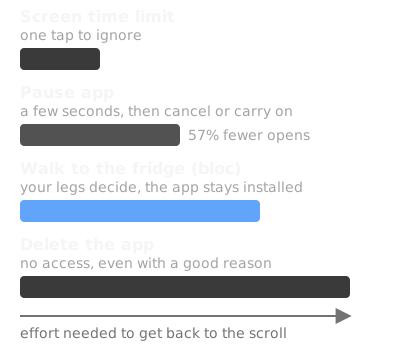
Bar lengths are illustrative. The 57% figure is from Grüning, Riedel and Lorenz-Spreen, PNAS, February 2023.
What bloc cannot do, to be plain about it. It cannot make reels less interesting. It cannot stop you walking to the fridge at 1 am; it only makes you do it on purpose. And if the scroll is standing in for something heavier (loneliness, anxiety, a job you dread), a device will not fix that. It will give you a quieter evening in which to notice it.
Six things to do tonight, free
- ·Charge your phone outside the bedroom. The other-room effect has the strongest evidence on this list. A cheap alarm clock replaces the excuse.
- ·Turn off every notification that is not from a human. Keep calls and messages. Lose "someone you may know posted".
- ·Move Instagram and YouTube off your home screen. Last page, inside a folder. Two extra swipes is a small pause, and small pauses add up.
- ·Pick a "last reel" time and tell one person. A fixed end time beats a vague "less".
- ·Switch the screen to greyscale after 10 pm. Reels are built for colour. In grey they lose some of their pull.
- ·Put something else within arm's reach of the bed. A book, a notebook, a podcast queued on a speaker. Habits are easier to replace than to delete.
For a Reels-only plan, see how to stop Reels addiction without deleting Instagram.
bloc sits on your fridge. Your apps block on a schedule. Unblocking takes a walk. See how bloc works →
Sources
- ·Esya Centre and IIM Ahmedabad study, reported by Business Standard, Aug 2023.
- ·Reuters factbox, "India's vast internet, social media, apps market", 29 Jan 2026.
- ·Sensor Tower data on India's mobile hours in 2024, Communications Today.
- ·Nir Eyal, the Hook Model (Hooked, 2014), nirandfar.com.
- ·University of Michigan IHPI, "Social media copies gambling methods to create psychological cravings", May 2018.
- ·Adam Mosseri, "Instagram Ranking Explained", 31 May 2023.
- ·Mona et al., short video addiction systematic review, International Journal of Adolescence and Youth, 2026.
- ·Wakefit, Great Indian Sleep Scorecard, March 2026.
- ·Cleveland Clinic, "Social media and body image", July 2023.
- ·Nene and Olayemi, Indian Journal of Clinical Anatomy and Physiology, 2023.
- ·Cheng et al., "Prevalence of social media addiction across 32 nations", Addictive Behaviors, 2021. DOI, abstract.
- ·Ward et al., "Brain Drain", Journal of the Association for Consumer Research, 2017.
- ·Grüning, Riedel and Lorenz-Spreen, the one sec study, PNAS, Feb 2023.
- ·Hunt et al. 2018, reported by Penn Today.
bloc is our product. We make and sell it, so read anything this article says about bloc as the maker's view. Every other claim links to its source.
Spot a mistake? Email support@letsbloc.com. We check it, fix it and update the date above.
Founder of bloc. IIT Kharagpur. Formerly a senior product analyst at BharatPe. Builds bloc full time from Bir, Himachal.
Free tools from bloc
Frequently asked questions
Why can't I stop scrolling?
Because the feed is built like a slot machine. Most reels are forgettable, but every few swipes one is perfect for you, and your brain keeps swiping for the next one. The feed also learns from every reaction and picks the next reel to keep you watching. That is design, not weak willpower.
Is reels addiction a real addiction?
Social media addiction is not a formal diagnosis in the main clinical manuals, but the behaviour is measured in research. A 2021 meta-analysis of 34,798 people across 32 nations found prevalence between 5% and 25% depending on the cut-off used. If scrolling is costing you sleep, work or relationships and you keep failing to cut back, that pattern is worth taking seriously, whatever you call it.
How do I reduce screen time without deleting Instagram?
Change the environment rather than your willpower. Keep the phone out of the bedroom. Turn off notifications that are not from people. Add a pause or some distance before the apps open. Set a fixed time when the feed closes for the day. A short delay with a cancel option cut app openings by 57% in one study, and a phone in another room measurably frees up attention.
Why don't the built-in screen time limits work?
Because the limit is dismissed with a single tap on the same screen. The friction is a few seconds and it sits in the same place as the temptation. Limits that work put the decision somewhere else: a different room, a different device, or a pause with a real choice.
Does blocking need a tap on the bloc?
No. Apps are blocked on their own, on a schedule you set in the bloc app or when you start a session from the app. Tapping your phone on the bloc is only for unblocking. The walk to the bloc is the point.
Can a family share one bloc?
Yes. Several phones can pair with the same bloc, so a family can share one bloc on the fridge.
Ready to stop doomscrolling for good?
Try bloc, the device that actually keeps you off your phone
One-time purchase · Free shipping across India · 30 day replacement guarantee
Order bloc, from ₹1,699