In this article8 sections
Willpower is not enough to stop doomscrolling because it runs low by the evening, and the feed is built to keep you scrolling through exactly those moments. What works is changing the setup so stopping does not need willpower: fewer cues, more friction between you and the app.
bloc (by Letsbloc) is built on that idea: a small NFC magnet for your fridge plus a free app for iPhone and Android. Your chosen apps block on a schedule, and unblocking early takes a walk to the fridge. ₹1,699, pay once. More at the end. First, why the scroll keeps winning.
In 30 seconds
- ·Willpower runs out. After a long day, the self control part of the brain shows sleep like activity on EEG.
- ·The feed is built to win. No bottom to the page, random rewards, bad news first.
- ·App timers live in the same phone. Ignore Limit is one tap away.
- ·What works is a better setup. Small changes to the phone cut use in trials. Physical distance is the strongest version.
You have tried. You put the phone face down and lasted eleven minutes. You deleted Instagram, felt great for a day, and reinstalled it "just to check one thing". You promised yourself no scrolling in bed and woke up at 7 am already deep in a thread.
You are not weak. You are a human brain up against software designed by thousands of behavioural scientists. That was never a fair fight.
You have already tried willpower
Researchers at UC San Diego describe doomscrolling as "a compulsive, almost mindless consumption of news, often without a real goal". People see it in themselves, feel bad about it, and still cannot stop.
It is not a small group. A 2024 Morning Consult survey found 53% of Gen Z adults and 46% of millennials regularly doomscroll. A Payless Power report cited by Forbes puts it at 64% of Americans, 43% every day.
That is not a minority of weak willed people. That is most people. The problem is the system, and the tools we use to fight it.
Why willpower runs out by 11 pm
Psychologists have long argued that self control is like a muscle that tires with use. The idea is called ego depletion: the more decisions and temptations you handle in a day, the harder the next one gets. It is still debated, and a 2024 review in Current Opinion in Psychology takes stock of where the evidence stands.
The brain evidence is newer. In a 2024 study from the IMT School for Advanced Studies Lucca, published in PNAS, people did an hour of tiring mental tasks while wearing EEG caps. Afterwards, brain waves typical of sleep appeared in parts of the frontal cortex, the region that handles decisions and self control. The researchers call it "local sleep".
Now think about when you doomscroll most. Not at 9 am on a rested Tuesday. It is 11 pm, after a day of meetings, decisions and low grade stress. The self control part of your brain is half asleep, and the feed is at its most tempting.
The American Psychological Association notes that people name lack of willpower as the number one reason they fail to change a habit. That belief turns a design problem into a personal failure. It is not personal. It is tiredness meeting a feed built for it.
Your feed is built to keep you scrolling
This is not a metaphor. It is the product brief.
No bottom to the page. Aza Raskin, who built the first infinite scroll in 2006, told the BBC: "If you don't give your brain time to catch up with your impulses, you just keep scrolling." The end of a page used to be the moment you could ask, "do I want to keep going?" Infinite scroll removed it.
A slot machine in your pocket. That is how Tristan Harris, a former design ethicist at Google, describes social media. Every pull of the feed might give you something (a message, a funny video, a post that makes you angry) or nothing. Rewards that arrive at random are the hardest kind to stop chasing. A 2025 paper in Behavioral Sciences says the same about likes, notifications and messages: they arrive unpredictably, so you keep checking. Over time it becomes a reflex, not a choice.
Bad news first. Humans notice threats more than pleasant things, and algorithms surface whatever gets the strongest reaction. Psychologists at Middle Georgia State University call doomscrolling "your brain's ancient threat-detection system running wild in the digital age". Part of your brain thinks the scrolling keeps you safe.
The cost is real. Harvard Health points to a 2023 review of about 1,200 adults linking doomscrolling to worse mental wellbeing and lower life satisfaction, and a 2024 study of 800 adults linking it to greater existential anxiety. The thing you do to calm the unease makes it worse.
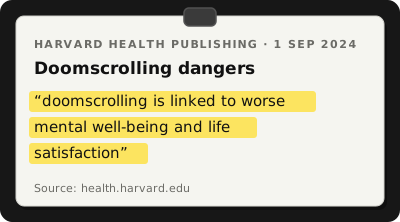
From Harvard Health Publishing, 1 September 2024.
Why app timers and blockers do not hold
App based limits have one basic flaw: they live inside the phone they are trying to limit, and getting past them takes a couple of taps.
On iPhone, you can tap "Ignore Limit" when a Screen Time alert fires. You can delete and reinstall an app. You can change the time zone to confuse Downtime. WikiHow has a 12 step guide to bypassing Screen Time.
A 2023 review in the Journal of Medical Internet Research looked at 13 apps built to reduce phone use. Most of the evidence behind them was weak or mixed, and the authors said more research is needed. The deeper issue: every software limit still depends on you not overriding it, at 11 pm, when your self control is in local sleep.
Everyone we interviewed before building bloc had tried software blockers, and every one of them had found a way past. App timers, screen time limits, deleting the apps, even a second phone. None of it stuck.
The failure is not personal. It is in the design.
What actually works: change the setup, not yourself
People do not weigh up each decision. We take the path of least resistance. Change the path, and the behaviour changes. This is the idea behind nudge theory, from economists Richard Thaler and Cass Sunstein, and the design word for it is friction.
James Clear puts it plainly in Atomic Habits: "The people with the best self control are typically the ones who need to use it the least. The way to improve these qualities is not by wishing you were a more disciplined person, but by creating a more disciplined environment."
A biscuit in your hand versus a biscuit in a shop across town. The biscuit has not changed. The distance changes the decision.
Two trials show it:
- ·A 2022 trial at McGill University, in the International Journal of Mental Health and Addiction, gave people ten small changes to their phone and habits: grayscale, non essential notifications off, phone out of the bedroom at night, and similar. Problematic smartphone use fell to normal levels within two weeks and stayed there for at least six weeks.
- ·A 2022 field experiment in Cyberpsychology, Behavior, and Social Networking with 112 people compared one design change (grayscale screen) against self set time limits. The design change "led to an immediate, significant reduction of objectively measured screen time". The time limits led to a smaller, slower drop.
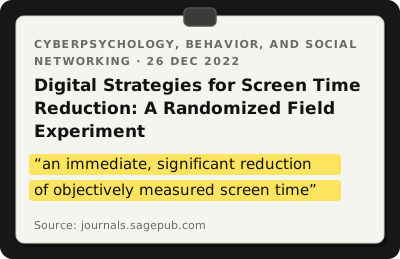
From Cyberpsychology, Behavior, and Social Networking, Zimmermann and Sobolev, published online 26 December 2022.
Those are small frictions. They work because they change what is easy, not because you try harder. Physical distance is the same idea taken further: if the exit is in another room, the urge has to survive a walk.
Not "use more discipline". Change the setup so discipline is not needed.
Where bloc fits
Most tools fight your phone with your phone. bloc puts the exit somewhere else.
bloc is a small NFC device with a magnetic back that sits on your fridge, paired with a free app for iPhone and Android (bloc for Chrome covers websites). You pick the apps. They block on their own, on a schedule you set or in a session you start. Open a blocked app and you see a shield screen with a limited peek, not the feed.
To unblock early, you walk to the fridge and tap your phone on the bloc. That is the only thing the tap does. The blocking runs by itself.
- ·The walk is the point. Long enough for the urge to fade and for you to notice you are choosing. Often you do not bother.
- ·Nothing to talk yourself past. There is no Ignore Limit button in bed at midnight.
- ·The feed's trick, turned around. The apps were designed to remove friction. bloc adds it back. ₹1,699, pay once, no subscription.
This is not about punishing yourself or building a prison around your phone. It is environment design, the thing that makes the feed sticky, used for you instead of against you.
You do not need more discipline. You need a better setup.
If you have been blaming yourself for failing to stop doomscrolling, you can stop. You were never losing a battle of willpower. You were playing against a design built to keep you scrolling, and your brain worked exactly as it should.
Environments can be changed. When the exit is in the kitchen, the choice looks different. You do not have to fight a craving every night. You just have to walk, and sometimes you will not bother.
That is not a failure of character. That is the setup working.
Sources:
- ·Ego depletion and willpower, PubMed / Current Opinion in Psychology (2024)
- ·Mental fatigue and local sleep in the frontal cortex, Medical Xpress / PNAS (2024)
- ·Doomscrolling prevalence, Morning Consult (2024)
- ·64% of Americans identify as doomscrollers, Forbes / Payless Power (2025)
- ·Doomscrolling health effects, Harvard Health (2024)
- ·Doomscrolling psychology, UC San Diego (2025)
- ·Doomscrolling and wellbeing, Applied Research in Quality of Life / PMC (2022)
- ·Social media variable reinforcement, Behavioral Sciences / PMC (2025)
- ·Infinite scroll addiction, UX Collective (2020)
- ·Social media deliberately addictive, BBC (2018)
- ·Screen time app effectiveness, JMIR (2023)
- ·Nudge based intervention for problematic smartphone use, McGill / IJMHA / PMC (2022)
- ·Digital strategies for screen time reduction, Cyberpsychology, Behavior, and Social Networking (2022)
- ·Environment design and habits, James Clear / Atomic Habits
- ·APA on willpower failure
bloc is our product. We make and sell it, so read anything this article says about bloc as the maker's view. Every other claim links to its source.
Spot a mistake? Email support@letsbloc.com. We check it, fix it and update the date above.
Founder of bloc. IIT Kharagpur. Formerly a senior product analyst at BharatPe. Builds bloc full time from Bir, Himachal.
Free tools from bloc
Frequently asked questions
Why doesn't willpower work for stopping doomscrolling?
Self control seems to wear down over a day of decisions, and a 2024 EEG study found sleep like brain waves in the decision making part of the brain after long mental effort. Doomscrolling happens in exactly those low moments: commutes, evenings, bed. And feeds are built with no natural stopping point, so it is not a fair fight.
What actually stops doomscrolling if willpower doesn't work?
Change the setup instead of yourself. Trials of small changes (grayscale, notifications off, phone out of the bedroom) show they cut use without needing discipline. Physical friction takes this further: if unblocking an app means walking to another room, the urge often passes before you get there.
How long does it take to break a doomscrolling habit?
There is no fixed number. In a 2022 trial at McGill University, ten small changes to how the phone was set up brought problematic smartphone use back to normal levels within two weeks, and the effect held for at least six weeks. Start with the setup, not with a promise to yourself.
Ready to stop doomscrolling for good?
Try bloc, the device that actually keeps you off your phone
One-time purchase · Free shipping across India · 30 day replacement guarantee
Order bloc, from ₹1,699