In this article8 sections
A dopamine detox is a planned break from the things that over stimulate you (reels, shorts, games, notifications) so that ordinary life feels rewarding again. You cannot lower your dopamine by avoiding your phone, and you would not want to. What works is cutting the cheap hits for a weekend to 30 days, and putting real friction between you and the apps.
That friction is the idea behind bloc, a small NFC device for your fridge with a free app for iPhone and Android. Your apps block on a schedule you set. Unblocking takes a walk. More on that in Step 4.
First, the moment you probably know. You open Instagram "just for a second". 45 minutes later you are watching a dog react to a lemon, and you have no memory of how you got there. Afterwards comes that hollow, restless feeling: you know you wasted the time, and you still want to scroll.
That feeling is what has millions of people searching for "dopamine detox". Some say it changed their life. Others call it pseudoscience. Both are a bit right.
The short version
- ·You cannot detox dopamine. The word is wrong, the practice is useful.
- ·Feeds are built like slot machines. The pull is design, not weak willpower.
- ·Pick a level (weekend, daily windows, or 30 days), replace the habit, and add physical friction.
- ·Expect two rough weeks. Keep the friction after you feel better.
What is a dopamine detox, really?
Dopamine is a chemical your brain makes and needs. It runs movement, motivation and learning. Harvard Health puts it plainly: "Dopamine is one of the body's neurotransmitters, and is involved in our body's system for reward, motivation, learning, and pleasure. While dopamine does rise in response to rewards or pleasurable activities, it doesn't actually decrease when you avoid overstimulating activities."
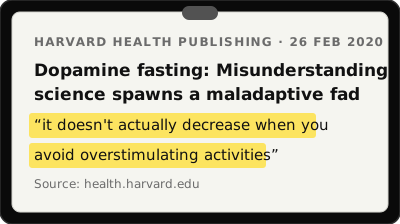
From Harvard Health Publishing, 26 Feb 2020.
The term was coined in 2019 by California psychologist Dr Cameron Sepah as a catchy name for a habit change approach borrowed from cognitive behavioural therapy (CBT): change what is around you so the habit has fewer triggers. He has said many times that the goal was never to lower dopamine. It was to stop grabbing instant rewards on autopilot.
So a "dopamine detox" is really a deliberate break from high stimulation, mostly social media, doomscrolling, gaming and constant notifications. Think of a sugar cleanse. Your body still makes glucose. You are only cutting the cheap, processed hits so that simpler, slower pleasures taste good again.
Why you can't stop scrolling (it's design, not willpower)
Dopamine is not the "pleasure chemical". Researchers like Wolfram Schultz and Joshua Berke have shown it is about wanting, not liking. It fires hardest when you expect a reward and are not sure you will get it.
That is why slot machines work. A 2010 gambling study, described here, found dopamine rose most not when people won, but when there was a 50/50 chance of winning. The hook is the anticipation, not the prize.
Every feed is built on this. You never know if the next post will be boring or brilliant, so each scroll is a pull of the lever. A Nature Communications study of over a million posts found that social media behaviour follows the same reward learning patterns used to study gambling and food reward in animals.
The effect does not stop when you put the phone down. A 2025 EEG study in Cureus recorded the brain activity of 100 adults while they used social media and found the changes continued after they stopped. A 2025 review in the same journal, summarising earlier studies, links heavy social media use to changes in dopamine pathways and to patterns that look like dependency, while noting that long term cause has not been proven.
Dr Anna Lembke, professor of psychiatry at Stanford and author of Dopamine Nation, describes the brain as a seesaw. Pleasure on one side, pain on the other. Every spike tips it towards pleasure, and the brain pushes back to restore balance. Stay on the pleasure side long enough and you come back to baseline feeling irritable, restless and flat, which sends you straight back to the phone.
Over time you need more stimulation just to feel normal. That is the state many of us are already in.
Signs you need a dopamine reset
You do not need to be "addicted" to benefit. If several of these feel familiar, a reset is worth trying.
- ·You open apps on autopilot. You unlock the phone without deciding to.
- ·Boredom feels unbearable. A queue or ten minutes without the phone is genuinely uncomfortable.
- ·Deep focus feels impossible. A book or one task without switching tabs keeps getting harder.
- ·Nothing feels satisfying. A walk, a meal, a conversation feels flat next to a feed.
- ·You feel worse after scrolling, and keep doing it anyway. That gap is the clearest signal.
- ·Your first and last acts of the day involve the phone.
The stakes are real. CDC data from 2024 found that US teenagers with 4 or more hours of daily screen time were more than twice as likely to report anxiety symptoms (27% vs 12%) and nearly three times as likely to report depression symptoms (26% vs 10%) as those with less. These patterns do not vanish at 18.
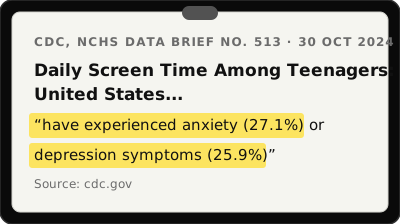
From CDC, NCHS Data Brief No. 513, 30 Oct 2024.
How to do a dopamine detox: 5 steps
This is not sitting in silence staring at a wall. That extreme, influencer version gives the practice a bad name. The goal is a reset you can actually keep.
1. Watch for two days
Change nothing yet. Notice which apps you open on autopilot, at what times, and what you were feeling just before (bored, anxious, avoiding a task). Open your phone's screen time report and look honestly. This is a map, not a judgement.
2. Pick your level
The Cleveland Clinic suggests treating it as an experiment, not a punishment.
| Level | What you do | Good for |
|---|---|---|
| Weekend reset | One tech light weekend a month: no social media, no streaming, few notifications | First timers |
| Daily windows | No phone for the first hour after waking, during meals, and 90 minutes before bed | Most people |
| 30 day trial | Drop the one app or habit you cannot control, for a month | A habit that feels out of control |
The 30 day version is Dr Lembke's. She told CNN: "I suggest a 30 day abstinence trial from the chosen problematic behaviour, rather than all rewards. This allows individuals to gauge the difficulty of stopping and assess any improvements in their well being after four weeks."
Start with the weekend or the daily windows if you are new. Consistency beats severity.
3. Replace, don't just remove
This is where most attempts fail. Remove the app with nothing to fill the gap, and the discomfort wins within hours. Give the same need a new outlet:
- ·Scrolling for connection? Call someone or plan a meet up.
- ·Scrolling to decompress? Walk, music, cook something.
- ·Scrolling to avoid a task? 25 minutes of work, 5 minutes off.
The question is not whether scrolling is bad and reading is good. It is whether you are choosing these things, or they are choosing you.
4. Add physical friction
Willpower runs out, and it runs out fastest when you are tired, stressed or bored, which is exactly when you reach for the phone.
What helps is making the habit harder to do. A 2025 scoping review of digital detox studies found that support, including tools that keep notifications off and keeping devices out of the bedroom, helped people manage cravings and stay motivated, and that limits tailored to the person were easier to stick to.
Distance is the simplest friction. Phone in another room while you work. Phone in a drawer at dinner. Phone on the kitchen counter at night, not the nightstand.
bloc makes that friction automatic. The small NFC device sticks to your fridge and pairs with a free app for iPhone and Android. You choose the apps and a schedule, and they block on their own. The only way to unblock early is to walk to the fridge and tap. Nothing high tech. It works because the thoughtless loop now has a walk in the middle of it.
5. Track the shift
For the first two weeks, keep a short note each day. Was focus easier? When did the craving hit? Dr Susan Albers at the Cleveland Clinic suggests watching your triggers: "Notice when the desire comes and how it ebbs and flows through your day."
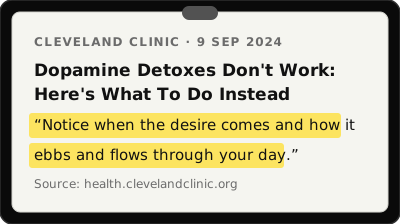
From Cleveland Clinic, 9 Sep 2024.
Judge the change at Lembke's four week mark, not before. The whole point of the trial is to see for yourself whether simpler things feel rewarding again.
Mistakes that undo a detox
- ·Going from 6 hours to zero in a day. That is a crash diet, and the rebound follows. Start with boundaries, not bans.
- ·Swapping one feed for another. Quit Instagram and spend six hours on YouTube, and nothing has changed. Lembke calls this cross addiction and warns plainly: "Don't just replace your one drug with another drug."
- ·Expecting week one to feel good. It usually does not. In a Huberman Lab conversation, Lembke describes patients feeling worse for the first two weeks and much better by week four. That is the seesaw settling, not failure.
- ·Treating it as a one time cleanse. The apps that pulled you in have not changed. The value is in new defaults you keep.
- ·Removing the friction once you feel better. This is the most common one. The pull does not disappear, it just gets quieter while you are not feeding it.
How to keep the reset
- ·Keep mornings phone free. The first hour is when your brain is clearest, so do not hand it to a feed.
- ·Decide a daily screen time budget in advance, and use the phone's own Screen Time or Digital Wellbeing as a starting point.
- ·Build offline things that compete: a sport, an instrument, cooking, a project. They get easier to choose once your baseline resets.
- ·Every few months, check your screen time honestly and delete what is only consuming you.
- ·Leave the block on. bloc works as a long term tool because the friction is physical. You cannot switch it off with one tap at 11 pm.
The real point
A dopamine detox is not about hating technology or becoming a monk. It is about taking back the choice.
Most scrolling is not chosen. It is a predictable response to systems designed by very clever people to hold your attention. You are not weak because you cannot stop. You are human, up against billion dollar behaviour design. The fix is not to try harder. It is to change your surroundings so the default changes.
Start small. Pick one boundary, hold it for a week, and see what shifts. The clarity after even a few quiet days tends to be its own motivation.
bloc sits on your fridge. Your apps block on a schedule. Unblocking takes a walk. See how bloc works →
bloc is our product. We make and sell it, so read anything this article says about bloc as the maker's view. Every other claim links to its source.
Spot a mistake? Email support@letsbloc.com. We check it, fix it and update the date above.
Founder of bloc. IIT Kharagpur. Formerly a senior product analyst at BharatPe. Builds bloc full time from Bir, Himachal.
Free tools from bloc
Frequently asked questions
What is a dopamine detox?
A dopamine detox is a planned break from the things that over stimulate you, mainly social media, gaming and streaming, so that ordinary life feels rewarding again. You cannot lower your dopamine by avoiding your phone, and you would not want to. The real goal is to break the habit of reaching for instant rewards on autopilot.
How long should a dopamine detox last?
Start small: one tech light weekend, or phone free windows every day (the first hour after waking, meals, the last hour before bed). For a habit that feels out of control, Dr Anna Lembke suggests a 30 day break from that one thing. She says most people feel worse for the first two weeks and better by week four.
Does dopamine detox actually work?
The name is wrong, but the practice helps. Taking a break from feeds and games lets slower rewards feel good again, and studies of digital detox find people manage cravings better with support, such as notifications off and devices out of the bedroom. What makes it stick is friction: making the apps harder to open, not trying harder.
Ready to stop doomscrolling for good?
Try bloc, the device that actually keeps you off your phone
One-time purchase · Free shipping across India · 30 day replacement guarantee
Order bloc, from ₹1,699